Sepsis kills someone roughly every two minutes. For decades, clinicians have tried to catch it earlier and for decades, by the time the classic signs appear, it's often too late. Then AI systems trained on millions of patient records started flagging deterioration risk hours before any human would have noticed the pattern. Not as a pilot programme. Not as a future ambition. Right now, in live hospitals.
That's not a press release. That's the gap between what we've been promised about AI and what it's actually delivering and the gap is closing faster than most people realise. Here's what actually matters: AI isn't solving the easy problems. It's working on the ones that stumped entire fields for generations.
How AI Is Catching Diseases Humans Keep Missing?
Medical diagnosis is a brutal domain to work in. You're pattern-matching across millions of variables, often under time pressure, with incomplete information, and the margin for error is someone's life. It's exactly the kind of problem that makes doctors burn out — and exactly the kind of problem that AI is built for.
Take diabetic retinopathy. It causes blindness, but it's entirely preventable if caught early. The catch is that screening requires a trained ophthalmologist reading retinal images a resource that's simply not available at scale in lower-income countries. Google's DeepMind system, working on real clinical datasets, has demonstrated screening accuracy matching or exceeding specialist ophthalmologists in controlled settings. In practice, that means a nurse with a camera and a tablet can run the screen. The specialist bottleneck disappears.
Drug discovery is equally striking. Identifying a viable drug candidate historically took years and cost hundreds of millions of pounds before anything even reached clinical trials. AI systems from companies like Recursion Pharmaceuticals and Insilico Medicine have compressed early-stage candidate identification from years into months not by guessing, but by modelling protein interactions at a scale no research team could manage manually.
And then there's sepsis prediction. Systems like the Epic Sepsis Model embedded in hospital EHR platforms analyse dozens of live patient signals continuously, flagging risk scores that give clinicians hours of lead time they didn't have before. The model isn't perfect, and let's be honest about this: it generates false positives that create alert fatigue. That's a real problem. But a false positive that triggers a check is categorically different from a missed sepsis case that kills someone.
Worth pausing on: the human cost of late diagnosis is almost never included in the conversation about AI accuracy. We talk about specificity and sensitivity percentages, but we don't talk about what a two-hour head start means for a patient in septic shock. The numbers tell a different story when you frame it that way.
Why Climate Scientists Are Handing Their Hardest Problems to AI
Climate modelling has always been a trade-off between resolution and speed. You could run a detailed simulation of a small region, or a coarser simulation of the whole planet not both, not at useful speed. AI is changing that constraint.
Google DeepMind's GraphCast weather model, released in late 2023 and now widely used in operational forecasting pipelines as of 2026, produces 10-day global weather forecasts in under a minute on a single machine. Traditional ensemble forecasting methods running on supercomputers take hours. The accuracy is comparable or better on many metrics, particularly for extreme weather event prediction — which is exactly where the stakes are highest.
But prediction is only half the battle. The harder problem is actually doing something with the information in time.
Agentic AI systems are being used to manage energy grids in near-real-time, adjusting supply from wind and solar sources based on weather forecasts, demand predictions, and grid stability signals simultaneously. DeepMind's work with National Grid in the UK demonstrated that AI-assisted wind energy predictions could cut the error rate significantly compared to conventional methods — which directly translates into less backup fossil fuel capacity needed on standby. Not a marginal gain. A structural one.
Water management is less glamorous but arguably more urgent. Drought-prone regions in California, Australia, and sub-Saharan Africa are using AI systems to monitor soil moisture via satellite, model reservoir depletion rates, and allocate irrigation resources to maximise yield while minimising water use. These aren't research projects. They're operational systems making real decisions about where limited water goes.
Deforestation monitoring is another case where AI has effectively solved a problem of scale. Before machine learning was applied to satellite imagery analysis, identifying illegal logging in the Amazon required human analysts reviewing footage across an area the size of a continent. Organisations like Global Forest Watch now use AI to flag changes automatically, with alerts generated within days of tree cover loss appearing. In practice, that means enforcement agencies and indigenous land defenders get actionable intelligence rather than outdated reports.
What Supply Chains Actually Owe AI Right Now
The 2021 and 2022 supply chain crises were a masterclass in cascading failure. A factory shuts in one country, a port gets congested in another, a retailer runs out of a component that costs £0.30 and can't ship a product that costs £3,000. The interdependencies were always there — we just couldn't see them clearly enough to respond before the damage was done.
Agentic AI systems can now monitor those interdependencies continuously. They pull in live shipping data, weather disruption forecasts, supplier financial health signals, and port congestion metrics and they surface re-routing options before the disruption becomes a crisis. Companies like Flexport and project44 have built these capabilities into logistics platforms that large manufacturers now rely on operationally.
Food waste is a version of the same problem with a moral dimension. Roughly a third of all food produced globally is wasted — a statistic that's been quoted for years with relatively little progress. AI-driven demand forecasting tools used by supermarket chains have started to dent that number meaningfully. By predicting which products will sell in which quantities at which stores based on weather, local events, promotional calendars, and historical patterns simultaneously, these systems reduce over-ordering. Less waste. Better margins. And — worth saying plainly less food thrown away when people are going hungry.
Fraud detection deserves mention here because the scale is routinely under-appreciated. Global payment fraud costs run into hundreds of billions annually. Real-time AI systems processing millions of transactions per second, flagging anomalous patterns that no human analyst could spot at speed, are now foundational infrastructure for every major bank and payment processor. The numbers tell a different story to the public perception of AI as a productivity tool this is AI as an active economic defence system.
Traffic management is the everyday version. Cities including Amsterdam, Singapore, and Los Angeles have deployed AI-optimised signal timing that responds to live traffic density rather than running fixed cycles. The efficiency gains are modest individually but significant at city scale fewer idling vehicles, lower emissions, less time wasted.
The Problem Nobody Talks About: Who Gets Access to This
Most AI coverage focuses on the capabilities of models and the valuations of companies. Almost nobody talks about whether these tools are actually reaching the people with the most to gain from them.
Let's be honest about this: if the primary beneficiaries of AI problem-solving are well-resourced hospitals in wealthy countries, well-capitalised logistics firms, and students at institutions that can afford the best software, then we've built a very sophisticated mechanism for widening existing gaps.
The more interesting story and the one competitors consistently miss is where AI is actually extending access to people who've historically been locked out.
Real-time AI translation is the clearest example. Tools like Google Translate and DeepL have become genuinely useful rather than a punchline good enough that a Spanish-speaking parent can have a substantive conversation with an English-speaking teacher via a phone screen. That's not a minor convenience. For a first-generation immigrant family, that's access to a system that previously excluded them.
AI-powered personalised learning is doing something similar in education. Systems like Khan Academy's Khanmigo tutor adapt explanation depth and pacing to individual student responses in real time. A student in rural India or rural Wales with a phone and an internet connection gets a tutoring experience that was previously available only to children whose families could afford it. [LINK: AI tools for personalised education]
For people with visual impairments, tools built on large vision models including object detection, scene description, and document reading are now available at a quality that was simply impossible five years ago. Microsoft's Seeing AI and similar applications describe surroundings, read labels, and interpret documents in real time. That's independence. Practical, daily independence.
And in healthcare returning there because it earns it AI diagnostic tools deployed via smartphone in low-resource settings are beginning to address the specialist access problem at the base of the pyramid. Organisations like Peek Vision use AI-assisted eye screening tools that health workers with minimal training can operate effectively. The expertise doesn't have to be in the room.
That's the theory — the reality is messier. Access still depends on connectivity, device availability, and local implementation capacity. AI doesn't erase infrastructure gaps by existing. But the directional shift is real, and it matters.
The Verdict
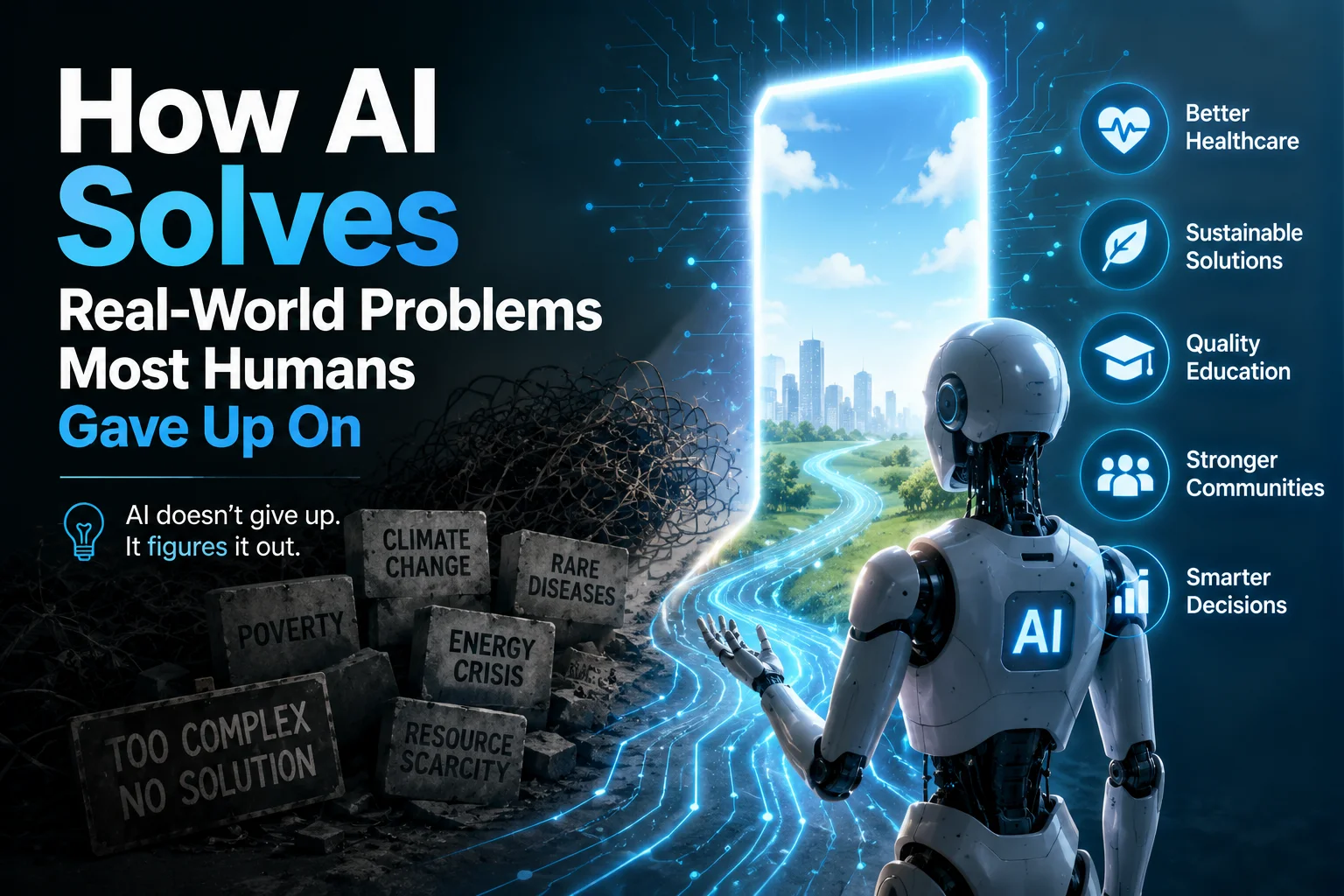
AI is already solving real-world problems that stumped entire fields for decades not in labs, not in demos, but in live hospitals, energy grids, food supply chains, and classrooms. If you're trying to understand where AI actually creates value versus where it generates noise, focus on the domains where the cost of being slow or wrong is high and the data is rich: medical diagnosis, climate systems, logistics, and accessibility tools. The equity angle is where the most interesting and most underreported progress is happening. The models will keep improving. The implementation gaps are what need attention now.
Frequently Asked Questions
How does AI solve real-world problems in healthcare?
AI solves healthcare problems primarily through pattern recognition at scale. Medical imaging analysis reading X-rays, MRIs, retinal scans is now AI-assisted in many clinical settings, with systems matching specialist-level accuracy on specific tasks. Predictive models flag patient deterioration risk hours before clinical signs appear. Drug discovery timelines have compressed significantly as AI models screen candidate compounds computationally rather than through purely physical experimentation. The practical effect is earlier intervention, better resource allocation, and faster development cycles for treatments.
What problems can AI solve in the future?
The near-term frontier involves problems that require integrating large volumes of heterogeneous real-time data: personalised cancer treatment selection based on genetic profiles, autonomous management of national energy grids responding to climate variability, and early detection of pandemic outbreaks from epidemiological signals. Longer term, AI systems capable of sustained scientific reasoning could meaningfully accelerate protein structure research, materials science for battery development, and climate intervention modelling. Take that with a grain of salt when timelines are claimed implementation lags capability by years in most cases.
Can you give examples of AI actually solving problems right now?
Yes, concretely. DeepMind's GraphCast is in operational use for weather forecasting as of 2026. AI sepsis prediction tools are embedded in hospital EHR systems across the NHS and major US health systems. AI-driven demand forecasting is used operationally by major supermarket chains to reduce food waste. Real-time fraud detection AI processes transactions at every major bank. AI translation tools are used daily by hundreds of millions of people. These aren't pilots they're infrastructure.
If you could solve one problem with AI, what would it be?
Personally? Diagnostic access in low-resource settings. The gap between the quality of diagnosis available to someone in London and someone in rural sub-Saharan Africa is enormous, and it kills people who didn't have to die. AI specifically, models that can run on modest hardware with limited connectivity has a credible path to narrowing that gap. Not eliminating it. But narrowing it substantially. That's where the return on applied AI investment, measured in lives rather than margins, is highest.
What are the limits of what AI can solve?
Significant ones. AI systems perform poorly on problems with insufficient historical data, rapidly shifting dynamics that don't resemble training distributions, and tasks requiring genuine causal reasoning rather than correlation-based prediction. They also don't solve political or economic problems AI can model optimal water allocation in a drought, but it can't force governments to implement it. Implementation capacity, infrastructure, and human decision-making remain the binding constraints in most real-world deployments. Knowing what AI can't do is at least as useful as knowing what it can.