The search results page is disappearing
For twenty-five years, being "visible in search" meant one thing: rank high enough in a list of blue links that someone clicks through. That model is breaking down. When someone asks ChatGPT, Google AI Mode, Perplexity, or Copilot a question today, they often get a complete, synthesized answer with a handful of cited sources and never see a traditional results page at all. Google's AI Overviews now appear on roughly 50–60% of U.S. searches, and ChatGPT alone processes on the order of two billion queries a day. For a huge and growing share of searches, the only way to reach the person asking the question is to be one of the small number of sources the AI actually cites.
This guide is about how that citation decision actually gets made grounded in the primary documentation Google, OpenAI, and Perplexity themselves publish, the peer-reviewed research that first measured this systematically, and current industry data — not speculation dressed up as certainty.
Part 1: The discipline has a name, and it has real research behind it
The term Generative Engine Optimization (GEO) was coined in a 2023 paper by researchers at Princeton University, Georgia Tech, the Allen Institute for AI, and IIT Delhi — "GEO: Generative Engine Optimization" (Aggarwal, Murahari, Rajpurohit, Kalyan, Narasimhan, and Deshpande), later presented at the ACM SIGKDD 2024 conference. It's worth understanding what this study actually found, because a lot of what circulates online as "AI SEO advice" either overstates or misreads it.
The researchers built GEO-bench, a benchmark of roughly 10,000 real user queries across nine domains, and tested nine distinct content-modification strategies against it — then validated the strongest ones against a live system, Perplexity.ai. Three strategies clearly outperformed the rest:
- Adding specific statistics (percentages, counts, dates, dollar amounts)
- Adding direct, attributable quotations from credible sources
- Citing sources for your own claims, inline
Combined, the strongest methods produced up to a 40% relative improvement in visibility inside AI-generated answers — with one especially interesting finding: pages that ranked poorly in traditional search (around position 5) saw the largest relative gains, a kind of equalizer effect. The paper also found that keyword stuffing — the one tactic borrowed directly from old SEO — made things worse, not better.
The deeper, more important finding is conceptual: generative engines evaluate content quality more directly than traditional search does. Classic search leans heavily on aggregate signals like backlink volume and historical traffic, which structurally favor large, established sites. An AI system deciding what to cite in a single answer is closer to reading and judging the content itself. That's genuinely good news for a smaller or newer site — but only if the content itself gives the AI something concrete to work with.
Part 2: "AI engines" are not one thing
It's a mistake to treat "AI search" as a single target to optimize for. The major systems retrieve information differently, weight different signals, and behave differently enough that a one-size-fits-all approach leaves real visibility on the table.
Google AI Overviews and AI Mode
Google's own developer documentation is direct on this point: there are no special requirements or separate optimizations to appear in AI Overviews or AI Mode. The guidance is simply to follow standard SEO best practices — the same helpful, people-first content and the same E-E-A-T signals that earn organic rankings. AI Overviews are built on a retrieval-augmented generation pipeline: Google interprets the query, retrieves relevant documents from its existing Search index, and passes them to its Gemini models to synthesize a cited answer. There's no separate "AI index."
That said, the relationship between organic rank and AI citation is shifting. Early data showed AI Overview citations closely tracked top-10 organic rankings, one analysis found roughly 76% of cited pages also ranked in the top 10 as of mid-2025. A more recent Ahrefs study covering over 4 million AI Overview URLs found that figure had fallen to 38% by early 2026. In plain terms: ranking well is still a real advantage, but it's no longer close to sufficient on its own a meaningful and growing share of what AI Overviews cite comes from outside the traditional top 10.
ChatGPT Search
OpenAI's own Publishers FAQ is unambiguous about the mechanics: your content needs to not be blocking OAI-SearchBot to be discoverable and citable in ChatGPT. OpenAI runs three separate, independently controllable crawlers, and conflating them is the single most common self-inflicted mistake in this space:
CrawlerPurposeControlled independentlyGPTBotCollects content for model trainingYesOAI-SearchBotPowers ChatGPT's search and citationsYesChatGPT-UserFetches a specific page only when a user explicitly asksYes
Blocking GPTBot does not block ChatGPT search citations, and allowing one doesn't automatically allow the others — each is its own switch in robots.txt. ChatGPT only produces genuine, verifiable citations when search is actively engaged; without it, any source-like text it generates is pattern-matched from training data and may not correspond to a real, current page at all.
Perplexity
Perplexity is architecturally different: it is built as a retrieval-first answer engine, and essentially every query triggers a live web search — unlike ChatGPT, which defaults to its training data unless search is invoked. Perplexity's own crawler documentation describes two agents: PerplexityBot, which builds its persistent index, and Perplexity-User, which fetches pages live during a user's session (and does not respect robots.txt, since it's acting on direct user request rather than automated crawling).
Multiple independent analyses converge on the same operational picture: Perplexity typically evaluates around 10–20 candidate pages per query and cites only 3–5 of them, weighting relevance, freshness, page structure, and corroboration across sources heavily — and it evaluates content freshness noticeably more aggressively than ChatGPT does, which matters a lot for anything time-sensitive.
Microsoft Copilot / Bing
Bing's generative experiences draw on the same underlying index as Bing Search, and Microsoft's own product team has confirmed publicly that structured data specifically helps Bing's models understand and correctly attribute content for Copilot answers.
The practical takeaway: crawler access is a hard, binary prerequisite everywhere, but source selection logic genuinely differs by platform — freshness matters more to Perplexity, established authority matters more to ChatGPT, and Google's system is the least separable from ordinary organic SEO of the four.
Part 3: How an AI engine actually decides what to cite
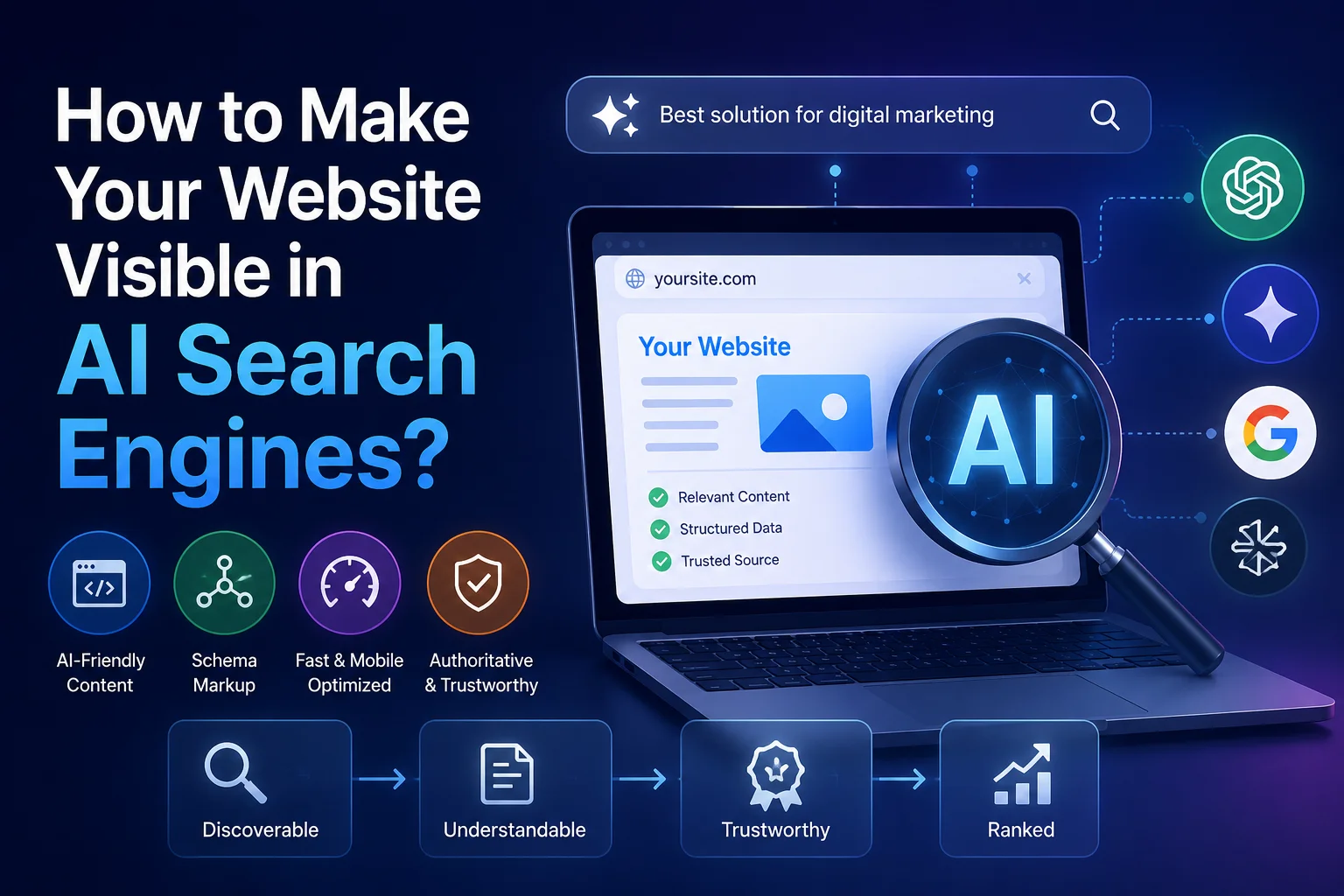
Strip away the branding and every one of these systems runs some version of the same three-stage pipeline:
Query
  ↓
Retrieval  — find candidate documents that might answer this
  ↓
Ranking / selection — filter down to the handful worth citing
  ↓
Generation — synthesize an answer, citing the sources actually used
Being indexed gets you into the candidate pool. It does not get you cited. This is the single most common misunderstanding in this space — people assume "my page is indexed" is close to "my page might get cited," when in practice, being retrieved as a candidate and being selected as an actual source are two very different filters, and most candidate pages fail the second one.
The two-gate model: selection vs. absorption
A genuinely useful distinction that's emerged from analyzing real citation behavior — most citation advice conflates the two, but they require different fixes:
- Citation selection — does the AI system retrieve and list your page as a source at all? This is a function of crawlability, indexability, relevance, and freshness.
- Citation absorption — does the AI's actual generated answer draw real, specific content from your page, or does your page just sit in a "sources" list unused? This is a function of how extractable and quotable your content actually is — whether a system can lift a specific claim, statistic, or definition out of your page without distorting its meaning.
A page can clear the first gate and completely fail the second — technically "cited," contributing nothing. That distinction is worth internalizing before spending money on either technical fixes or content rewrites, since they solve different problems.
Part 4: The technical foundation — none of this matters if the AI can't reach your page
This is unglamorous, and it's also where most real-world visibility failures actually originate.
Crawler access. Confirm you are not blocking the relevant search-citation crawlers in robots.txt — specifically OAI-SearchBot (ChatGPT), PerplexityBot (Perplexity), and the standard Googlebot (Google). A common, costly mistake: many CDN and WAF providers began blocking AI crawlers by default in 2025 — your robots.txt can be perfectly correct while your edge infrastructure silently blocks the request anyway. Check server logs, not just the robots file, to confirm access is actually happening.
Server-side rendering. Multiple independent analyses of Perplexity and ChatGPT citation patterns confirm that content requiring JavaScript to render receives citations at fundamentally lower rates — some crawlers do not reliably execute client-side scripts. If your page's actual content only appears after JavaScript runs, a meaningful share of AI crawlers may never see it at all.
Genuine indexability. No noindex on pages you want visible, no login walls or paywalls in front of the content you want cited (Perplexity's documentation notes explicitly that when its crawler is blocked by a paywall, it simply falls back to other, more accessible sources — your competitor, not you).
Clean, semantic HTML. Real headings, real lists, real tables — not divs styled to look like structure. This isn't stylistic preference; it's what lets a retrieval system parse what a section of your page is actually about without guessing.
Part 5: Content that gets absorbed, not just listed
Once a page clears the technical gate, what actually determines whether an AI system extracts something usable from it:
Answer the question directly, early, and in self-contained chunks. Content that works well for AI extraction tends to be structured as short, self-contained passages — often cited in the 40–60 word range — where each section can stand alone as a complete answer to a specific question, rather than requiring the surrounding paragraphs for context. This is a genuine shift from writing a flowing narrative essay toward writing a series of directly answerable sub-questions that also happen to read coherently as a whole page.
Be specific, not vague. This is the Princeton paper's strongest, most consistently reproduced finding: content with concrete statistics, direct quotations from credible sources, and inline citations for its own claims gets cited meaningfully more often than equivalent content without them. "Many businesses report improved results" gives an AI system nothing extractable. "A 2026 Ahrefs study of 4 million AI Overview URLs found 38% of cited pages ranked in the top 10 organically" gives it something concrete to lift directly into an answer.
Corroboration matters. Systems that cross-reference multiple sources before generating an answer favor claims that are independently corroborated elsewhere on the web over lone, uncorroborated assertions — even accurate ones. A self-published claim about your own business ("we are the best clinic in Dubai Marina") carries far less weight than the identical claim appearing in an independent review, a local publication, or a directory listing.
Freshness, especially for time-sensitive topics. Perplexity in particular weights recency heavily; for anything involving pricing, availability, or "best of" comparisons, content older than a few months measurably loses citation share to more recently updated pages covering the same ground.
Part 6: Structured data — a real signal, but not the one people think
There's a lot of confident-sounding misinformation here, so it's worth being precise about what's actually confirmed. Google's own developer documentation states plainly that structured data is not a direct ranking factor, and there is no special AI-specific schema — the standard schema.org vocabulary is what search engines use throughout. Both Google and Microsoft's Bing team have separately confirmed structured data helps their AI systems understand and correctly verify content, which is a different claim from "it makes you rank higher."
The practical way to think about it: structured data doesn't make weak content get cited. It removes ambiguity for content that's already good, so an AI system can resolve who you are, what you offer, and whether the claim is trustworthy with more confidence — which matters directly at the citation-selection stage, since an AI system that can't confidently resolve those basics is less likely to select you as a source in the first place.
For a local or service business specifically, the schema types worth prioritizing:
- Organization / LocalBusiness — name, address, phone, hours, service area
- FAQPage — genuine, distinct questions with complete answers, not a rehash of on-page headings
- Review / AggregateRating — where reviews are real and verifiable
- sameAs — links to your LinkedIn, Google Business Profile, and other authoritative profiles, which helps tie your on-site entity to the same entity search engines already recognize elsewhere
One instructive controlled experiment from Search Engine Land (September 2025) is worth citing directly: three near-identical pages were published with the same content and same target keyword difficulty, with structured data as the only deliberate variable. Only the page with well-implemented JSON-LD appeared in a Google AI Overview — and it also achieved the highest organic ranking. The page with no schema at all was never indexed. That's a single experiment, not a universal law, but it's a clean illustration of the mechanism: schema didn't "win" the citation on its own merits — it made an already-strong page legible enough to be trusted.
Part 7: Entity consistency and third-party authority
This is where GEO connects back to something SEO practitioners have understood for years but under-invested in: search and AI systems increasingly reason in terms of entities — a specific business, person, or organization with a consistent identity — not just keyword matches.
Audit your entity consistency. Does your business name, address, and description match, word for word, across your website, Google Business Profile, LinkedIn, industry directories, and any press mentions? Contradictions between these — even small, stale ones — measurably reduce a system's confidence in resolving who you actually are, which works directly against you at the citation-selection stage.
Independent corroboration outweighs self-claims. The distinction the research consistently draws: a business claiming "we are the leading provider of X" is a self-claim, carrying comparatively little weight; the same claim appearing in an independent industry publication, a client's public review, or a journalist's coverage is corroboration, and AI systems that cross-reference sources treat it very differently. This is the actual, durable case for digital PR and earned coverage in an AI-search world — not backlinks for their own sake, but independent, verifiable confirmation of who you are and what you're good at.
Part 8: A practical checklist
Technical foundation (do this first — nothing else matters without it)
- Confirm
OAI-SearchBot,PerplexityBot, and Googlebot are not blocked inrobots.txt - Confirm your CDN/WAF isn't silently blocking AI crawlers by default
- Confirm core content renders in raw HTML, not only after JavaScript executes
- No unintended
noindex, no login wall in front of content you want cited - Real semantic HTML — genuine headings, lists, and tables, not styled divs
Content structure
- Every page answers its primary question directly, near the top
- Content is broken into short, self-contained, directly-answerable sections
- Claims are backed by specific statistics, dates, and figures — not vague generalities
- Direct quotations and inline citations back your own claims where relevant
- Content is genuinely current — especially anything involving pricing or availability
Structured data
- Organization/LocalBusiness schema is present and accurate
- FAQPage schema reflects real, distinct questions with complete answers
-
sameAslinks your site to your other authoritative profiles - All JSON-LD validates cleanly (Google's Rich Results Test or an equivalent validator)
Entity and authority
- Business name, address, and description are word-for-word consistent across every platform
- Actively pursuing independent, third-party mentions — reviews, directories, press — not just self-published claims
Measurement
- Track AI citation rate and citation position, not just organic rank
- Track which competitors are being cited instead of you, and for which specific questions
- Distinguish "we were cited" from "our actual content shaped the answer" — the two-gate distinction from Part 3
The myths worth retiring
"There's a special AI schema I need to add." There isn't. Google's own documentation is explicit that AI Overviews and AI Mode use the same structured data vocabulary as regular Search — no separate markup exists.
"Keyword stuffing helps AI find me." The Princeton study found the opposite — keyword-stuffed content performed measurably worse at earning citations than natural, specific, well-sourced writing.
"If I rank #1 on Google, I'll automatically get cited by AI Overviews." It correlates, but the correlation is weakening — down from roughly 76% overlap to 38% in about a year, per Ahrefs' most recent large-scale analysis. Ranking well remains a real, meaningful advantage. It is no longer close to sufficient by itself.
"Being listed as a source means the AI actually used my content." Not necessarily — see the selection-versus-absorption distinction in Part 3. A citation with zero real content overlap is a much weaker outcome than one where the AI's answer actually draws from your specific facts and phrasing.
Where this actually goes from here
None of this is static. Google's AI Overviews rolled out iteratively across two years and are still evolving; OpenAI added new crawler agents as recently as this year; the gap between organic rank and AI citation has visibly widened over just the past twelve months of data. Treating any single guide — this one included — as a fixed, permanent playbook is itself a mistake. The organizations that will actually win at this over time are the ones running their own real experiments against their own real content, on a real cadence, and adjusting based on what their own data shows — not the ones copying a static checklist once and assuming it's done.
Sources referenced
- Aggarwal, Murahari, Rajpurohit, Kalyan, Narasimhan, Deshpande. "GEO: Generative Engine Optimization." Princeton University / Georgia Tech / Allen Institute for AI / IIT Delhi. ACM SIGKDD 2024. arXiv:2311.09735
- Google for Developers — AI Features and Your Website, Search Central Documentation
- OpenAI Help Center — Publishers and Developers FAQ
- OpenAI Help Center — ChatGPT Search
- Perplexity — official crawler documentation (PerplexityBot / Perplexity-User)
- Ahrefs — AI Overview citation analysis, ~863,000 SERPs / 4M+ AI Overview URLs (February 2026)
- Search Engine Land — controlled structured-data / AI Overview inclusion experiment (September 2025)
- BrightEdge — State of Structured Data industry research