
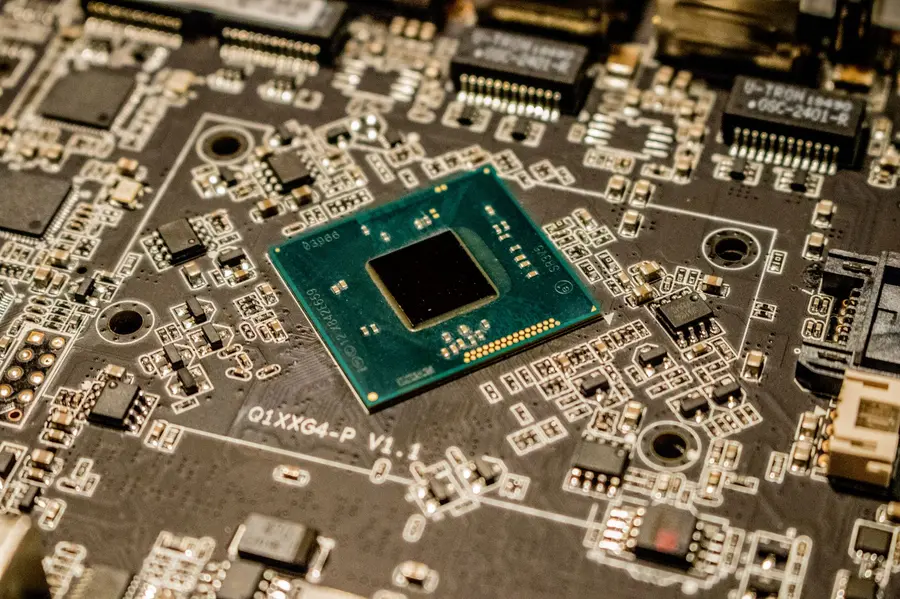
SK Hynix Raises $26.5B in Record US IPO, US Officials Urge New Chip Fabs
SK Hynix has closed the largest foreign IPO in U.S. history, raising $26.5 billion in a public offering that underscores the AI industry's insatiable appetite for high-bandwidth memory (HBM) chips. According to TechCrunch, the South Korean memory giant now faces mounting pressure from U.S. officials to build new fabrication plants on American soil.
The scale of the IPO — nearly double the previous record held by Alibaba's 2014 listing — reflects the strategic importance of HBM chips in powering AI workloads. SK Hynix dominates the HBM market, holding an estimated 53% share as of early 2026, with its HBM3E and next-generation HBM4 products serving as critical components for NVIDIA's Blackwell and Rubin GPU architectures, as well as AMD's MI400 series.
U.S. Commerce Secretary Gina Raimondo, speaking at the Nasdaq closing bell ceremony, publicly encouraged SK Hynix to expand its domestic presence. 'The AI revolution runs on memory, and that memory should be made in America,' she stated, according to TechCrunch's report. This aligns with the Biden administration's CHIPS and Science Act goals, though implementation has been slow with only two major fabs breaking ground so far.
For AI developers and hyperscaler operators, SK Hynix's U.S. expansion carries direct implications. Currently, supply chain concentration in South Korea creates vulnerability: a single geopolitical disruption could halt AI training clusters worldwide. Domestic fabrication would reduce latency for American cloud providers like AWS, Azure, and Google Cloud while diversifying production risks.
However, building HBM fabs is not trivial. These facilities require advanced through-silicon via (TSV) packaging capability, wafer-level stacking, and extreme ultraviolet (EUV) lithography — all of which demand cleanroom environments costing $10-15 billion per site. SK Hynix's IPO proceeds provide a war chest, but analysts at Gartner estimate a U.S. HBM fab would take 3-5 years to become operational and require a skilled workforce that currently does not exist at scale domestically.
Samsung, SK Hynix's chief rival, is also under pressure to establish U.S. fabs for its competing HBM technology. The two Korean giants accounted for 96% of global HBM output in Q2 2026, per industry data from TrendForce. Together they supply memory for training models like GPT-5, Gemini 3, and Llama 4 — all of which require enormous memory bandwidth to handle context windows exceeding 1 million tokens.
For businesses deploying AI workloads, the immediate risk is price volatility. HBM prices have risen 40% year-over-year due to demand outpacing supply. SK Hynix's U.S. listing transfers some financial risk to public markets, but until new fabs come online, allocation remains constrained. AI startups and mid-size enterprises may face longer wait times for GPU deployment with sufficient memory bandwidth.
The IPO also signals a maturation of the AI hardware ecosystem. Historically, memory was a commodity market with thin margins; today, SK Hynix commands valuation multiples closer to software companies. This shift means investors are betting that AI's memory demands will continue growing exponentially — a bet that requires shipping billions of GB of HBM annually for the next decade.
What this means for developers: While you may not directly purchase memory, your model training costs depend on HBM availability. Tight supply translates to higher instance pricing on cloud providers. If you are planning large-scale training runs for 2027, consider negotiating reserved capacity contracts now. SK Hynix's U.S. fab commitments, if realized, would structurally lower costs by 2029 — but that timeline remains uncertain.
TechCrunch's report also highlights that SK Hynix plans to use part of the IPO proceeds for R&D into HBM4e and future optical interconnects, which could reduce power consumption by 30% compared to current electrical links. For edge AI and mobile inference, this technology could eventually trickle down into lower-power devices.
The geopolitical dimension cannot be ignored. By listing on the NYSE and potentially building U.S. fabs, SK Hynix effectively hedges against export controls that could disrupt its Korean operations. This strategic move echoes TSMC's Arizona expansion — both aim to create redundancy in a supply chain that the U.S. government increasingly views as critical infrastructure.
For AI developers and business leaders, the key takeaway is that memory is no longer a background concern. It is now a first-order constraint on model size and training efficiency. Keep a close watch on SK Hynix's fab announcements over the next 12 months; they will directly affect your hardware roadmap and cloud budget. The age of memory-aware AI architecture design has arrived.
Related: Meta’s Modular AI Chips Enter Production in September: A Strategic Bet on Adaptability
Source: TechCrunch. This article was produced with AI assistance and reviewed for accuracy. Editorial standards.


