The Paradigm Shift: From Recurrence to Attention
Before 2017, the dominant architectures for sequence modeling—recurrent neural networks (RNNs) and long short-term memory (LSTM) networks—relied on sequential processing. Each token in a sequence was processed one step at a time, maintaining a hidden state that attempted to carry information forward. This sequential bottleneck made training slow, limited parallelization, and caused vanishing gradient problems for long-range dependencies. The landscape changed dramatically with the publication of "Attention Is All You Need" by Vaswani et al. from Google Brain in 2017. The Transformer architecture introduced a radical idea: replace recurrence entirely with attention mechanisms.
The core insight was that a model could learn which parts of an input sequence are relevant to each other by computing weighted sums of all positions simultaneously. This shift unlocked unprecedented scalability. Modern large language models (LLMs) like GPT-4 (OpenAI), Claude 3 (Anthropic), Gemini (Google DeepMind), and Llama 3 (Meta) are all built on Transformer variants. According to a 2023 Stanford AI Index report, over 70% of state-of-the-art NLP systems now rely on Transformer-based architectures. The change is not just academic—it has reshaped the entire AI industry, enabling models with hundreds of billions of parameters.
Core Mechanism: How Self-Attention Works
At the heart of every Transformer lies the scaled dot-product attention mechanism. The fundamental operation can be broken down into three learned vectors for each input token:
- Query (Q): Represents what this token is "looking for" in other tokens.
- Key (K): Represents what this token "offers" to others.
- Value (V): Represents the actual information content to be passed along.
The attention score between two tokens is computed as the dot product of the query of one and the key of another, divided by the square root of the key dimension (hence "scaled"). A softmax function then converts these scores into probabilities, which are used to weight the value vectors. The result is a context-aware representation where each token's output is a mixture of all other tokens, weighted by relevance.
For example, in the sentence "The bank of the river was muddy," the word "bank" must attend to "river" to disambiguate it from a financial institution. Self-attention allows this to happen in a single forward pass, not sequentially across the sentence. This parallel computation is why Transformers can be trained on massive datasets using GPUs and TPUs far more efficiently than RNNs.
Multi-Head Attention: Learning Multiple Perspectives
Single attention heads are powerful but limited—they can only capture one type of relationship at a time. Transformers address this with multi-head attention, where the Q, K, and V transformations are projected into multiple subspaces. Each "head" learns a different attention pattern. A 12-layer Transformer with 12 heads (like BERT-base) can learn 144 different relational patterns simultaneously.
Research from Google shows that different heads specialize: some focus on syntactic relationships (subject-verb agreement), others on positional relationships (adjacent words), and still others on semantic long-range dependencies. The outputs of all heads are concatenated and projected back to the model dimension. This redundancy and specialization is a key reason why Transformers outperform LSTMs on tasks like machine translation (BLEU score improvements of 5-8 points on WMT benchmarks) and question answering (SQuAD 2.0 F1 scores exceeding 90%).
Practical implementations like Hugging Face's Transformers library (over 200,000 GitHub stars as of 2024) make multi-head attention accessible to developers. Tools like PyTorch and TensorFlow provide optimized implementations, and companies like NVIDIA have developed fused kernels (e.g., FlashAttention) that reduce memory complexity from O(n²) to near-linear for long sequences.
Positional Encoding: Giving Order to the Chaos
Unlike RNNs, which process tokens sequentially and inherently encode position, Transformers process all tokens simultaneously. Without positional information, the model would treat "The cat chased the mouse" identically to "The mouse chased the cat." The solution is positional encoding—adding a unique signal to each token's embedding.
The original paper used sinusoidal functions of different frequencies: PE(pos, 2i) = sin(pos/10000^(2i/d_model)) and PE(pos, 2i+1) = cos(pos/10000^(2i/d_model)). This allows the model to learn relative positions because any fixed offset can be represented as a linear function of the original encoding. Modern variants like RoPE (Rotary Position Embedding, used in Llama and GPT-NeoX) and ALiBi (used in BLOOM) have improved upon this, enabling better extrapolation to longer sequences than seen during training.
GPT-4 reportedly handles context windows of up to 128,000 tokens, while Anthropic's Claude 3 supports 200,000 tokens. These capabilities directly stem from advances in positional encoding and attention efficiency. For developers, understanding these encoding schemes is crucial when fine-tuning models on domain-specific long documents (legal contracts, medical records, or code repositories).
Architecture Stack: Encoders, Decoders, and Everything In Between
The original Transformer paper proposed a sequence-to-sequence architecture with both an encoder and a decoder. The encoder uses bidirectional self-attention (each token can attend to all others), while the decoder uses masked self-attention (each token can only attend to previous tokens) plus cross-attention to the encoder output. This design is ideal for translation and summarization.
However, the community quickly realized that subsets of this architecture work well for specific tasks:
- Encoder-only models (BERT): Bidirectional context, excellent for classification, NER, and question answering. Google's BERT achieved state-of-the-art on 11 NLP benchmarks in 2018.
- Decoder-only models (GPT series): Autoregressive generation, ideal for text completion, chat, and code generation. OpenAI's GPT-4 is estimated to have over 1 trillion parameters.
- Encoder-decoder models (T5, BART): Best for translation, summarization, and structured input-output tasks. Google's T5 unified NLP tasks into a text-to-text format.
According to a 2024 analysis by Epoch AI, training costs for large Transformers have decreased by roughly 2x every 18 months due to hardware and algorithmic improvements. The Mixture-of-Experts (MoE) variant, used in models like Mixtral 8x7B (Mistral AI) and GPT-4, further reduces inference cost by activating only a subset of parameters per token.
Practical Impact: Real-World Applications and Benchmarks
The Transformer's attention mechanism has enabled breakthroughs across multiple domains beyond NLP:
- Computer Vision: Vision Transformers (ViT, 2020) match or exceed CNNs on ImageNet, with Google's ViT-G/14 achieving 90.45% top-1 accuracy.
- Speech recognition: Whisper (OpenAI) uses a Transformer encoder-decoder to achieve word error rates below 5% on multilingual benchmarks.
- Biology: AlphaFold2 (DeepMind) uses attention mechanisms to predict protein structures with atomic-level accuracy, solving a 50-year grand challenge.
- Code generation: GitHub Copilot (based on OpenAI Codex) and Amazon CodeWhisperer generate code from natural language descriptions, processing millions of requests daily.
For developers, the practical implications are immense. Frameworks like LangChain and LlamaIndex build on Transformer embeddings to create retrieval-augmented generation (RAG) pipelines. Companies like Pinecone and Weaviate offer vector databases optimized for attention-based embeddings. The market for Transformer-based APIs (OpenAI, Anthropic, Cohere, Google) is projected to exceed $15 billion by 2025.
Challenges and the Road Ahead
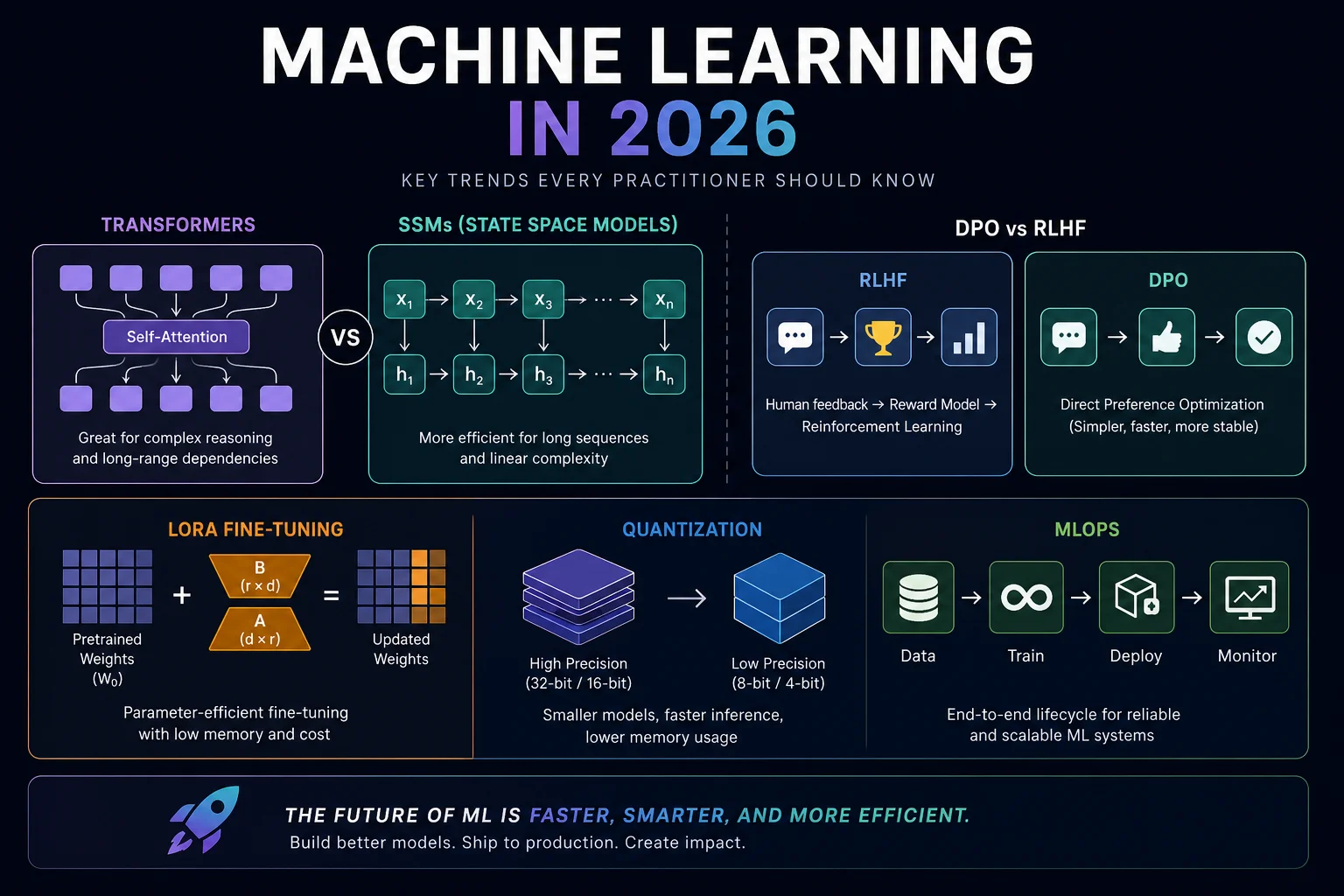
Despite its success, the Transformer architecture has known limitations. The quadratic memory complexity of full attention (O(n²) for sequence length n) makes processing very long sequences expensive. Sparse attention patterns (e.g., Longformer, BigBird) and linear attention (e.g., Performer) are active research areas. The Mamba architecture (2023) proposes state-space models as an alternative, achieving linear complexity while maintaining competitive performance on long-range tasks.
Another challenge is the "attention sink" phenomenon observed in LLMs, where models allocate excessive attention to initial tokens (like BOS tokens). This can degrade performance on tasks requiring precise long-range reasoning. Techniques like attention temperature scaling and head pruning are being explored to mitigate this.
Current research directions include: mixture-of-attention-heads (MoA), which dynamically selects attention patterns per token; retrieval-augmented attention, which combines parametric knowledge with external databases; and multi-modal Transformers that jointly attend over text, images, audio, and video. Meta's ImageBind and Google's Gemini are early examples of this trend.
Related: PP-OCRv6 Debuts on Hugging Face: 50-Language OCR With Models From 1.5M to 34.5M Parameters
Conclusion
The Transformer architecture, powered by attention mechanisms, fundamentally transformed machine learning by replacing sequential recurrence with parallel, content-based weighting. This shift enabled models to scale to hundreds of billions of parameters, achieve human-level performance on complex reasoning tasks, and generalize across modalities from text to proteins. For developers and tech professionals, understanding attention is no longer optional—it is the foundation upon which modern AI is built. As efficiency improvements like FlashAttention and sparse patterns continue to evolve, the Transformer's reign appears far from over, with its principles likely to underpin the next generation of AI systems.