Introduction: Beyond Next-Token Prediction
By early 2026, large language models (LLMs) have become deeply embedded in enterprise workflows, consumer applications, and scientific research. Yet the raw capabilities of these models—their ability to generate fluent, coherent text—are no longer the primary differentiator. What separates a useful AI assistant from a frustrating one is alignment: the model's ability to understand intent, avoid harmful outputs, and follow nuanced instructions. Reinforcement Learning from Human Feedback (RLHF) remains the cornerstone technique for achieving this alignment, though the methodology has evolved significantly since its popularization by OpenAI in 2022. This article provides a comprehensive, technical breakdown of how RLHF works in 2026, why it continues to matter for LLM development, and what practical considerations developers must understand.
The Core Mechanism: How RLHF Works
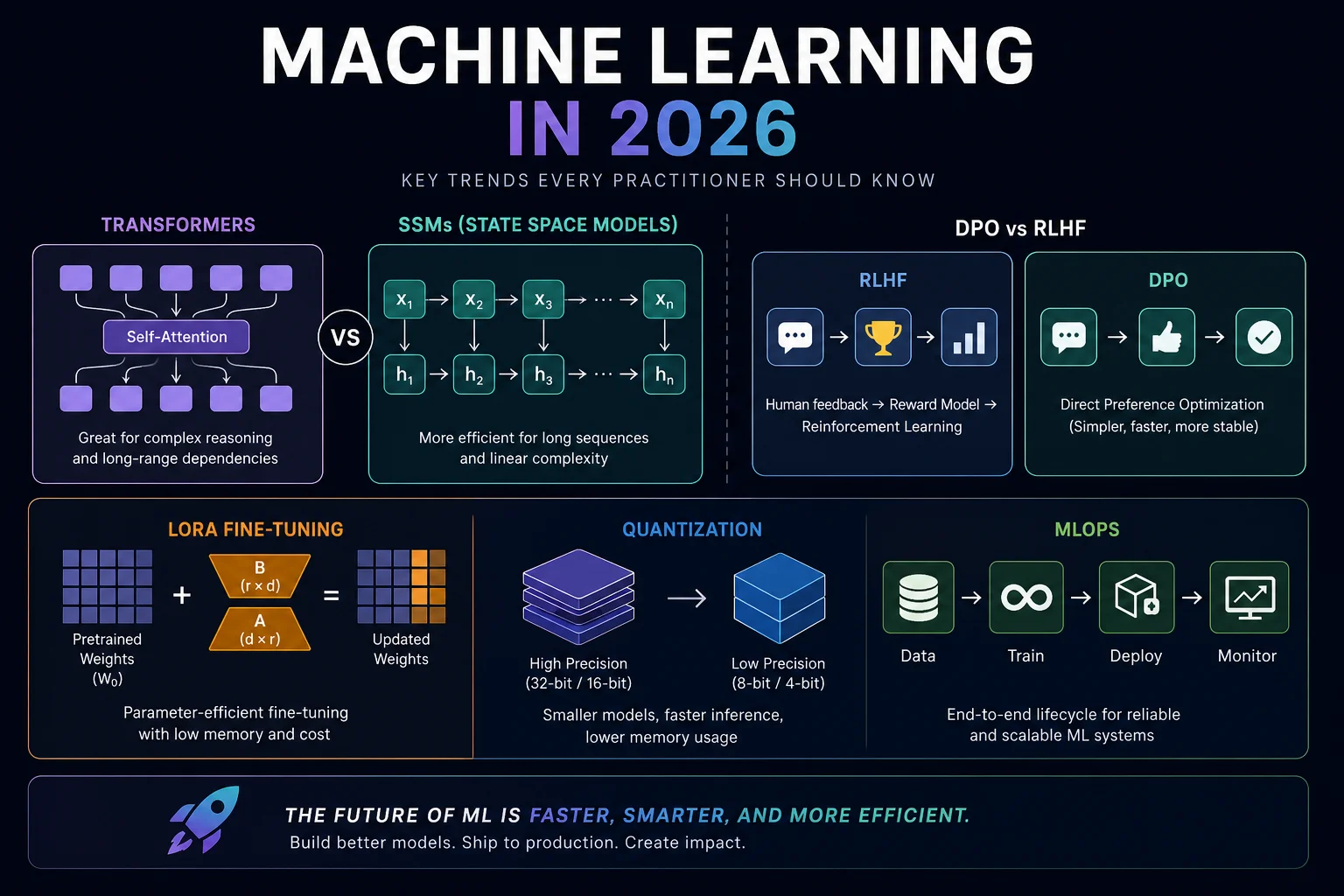
At its simplest, RLHF is a three-phase training pipeline that injects human preferences into a model's behavior. The process begins with supervised fine-tuning (SFT) on high-quality demonstration data, then moves to reward model training, and finally to reinforcement learning optimization. In 2026, the pipeline has been streamlined and made more robust, but the fundamental logic remains unchanged.
Phase 1: Supervised Fine-Tuning (SFT)
Before any reinforcement learning occurs, the base LLM—typically a dense transformer or mixture-of-experts architecture—undergoes supervised fine-tuning on curated datasets of human-written prompts and ideal responses. In 2026, leading models like Anthropic's Claude 4 and Google's Gemini 3.0 use SFT datasets that are not only large (often exceeding 100 million tokens) but also carefully balanced for diversity, instruction types, and safety edge cases. Companies like Scale AI and Surge AI remain dominant providers of these human-written demonstrations.
Phase 2: Training the Reward Model
The key innovation in RLHF is replacing a hard-coded loss function with a learned reward model. Human labelers are shown multiple model-generated responses to the same prompt and asked to rank them from best to worst. In 2026, this process has been refined to use comparative judgments (e.g., "Response A is better than Response B") rather than absolute scores, which yields more consistent data. The reward model—typically a transformer of 7 to 13 billion parameters—is trained to predict these human preferences. A notable development in 2025-2026 is the use of "reward ensembles": multiple reward models trained on different subsets of preference data, whose outputs are averaged during RL training to reduce reward hacking.
Phase 3: Reinforcement Learning Optimization
With the reward model fixed, the main LLM is fine-tuned using a reinforcement learning algorithm. Proximal Policy Optimization (PPO) was the original choice, but by 2026 it has been largely supplanted by more stable and sample-efficient algorithms. Direct Preference Optimization (DPO), introduced in 2023, is now the dominant approach because it eliminates the need for a separate reinforcement learning loop, directly optimizing the policy from preference data. However, many leading labs, including DeepMind and Mistral AI, use a hybrid approach: initial alignment via DPO followed by a short PPO stage using online human feedback to correct subtle misalignments. The training process typically runs for 1,000 to 5,000 gradient steps on clusters of 512 to 1,024 NVIDIA H100 or B200 GPUs, with total costs ranging from $500,000 to $5 million per model.
Why RLHF Matters for LLMs in 2026
The landscape of LLM development has shifted dramatically. In 2023, the primary challenge was scaling model size and training data. By 2026, with models exceeding 1 trillion parameters (e.g., Meta's Llama 4, xAI's Grok 3), the marginal utility of simply adding more data has diminished. Alignment quality is now the primary bottleneck to real-world deployment.
Safety and Harm Reduction
RLHF is the most effective known technique for reducing toxic outputs, biased responses, and harmful instructions. According to a 2025 study from the Center for AI Safety, models trained with RLHF show a 70-80% reduction in harmful completions compared to base models on standardized benchmarks like Anthropic's HarmBench and the MLCommons AI Safety Benchmark v1.0. In 2026, regulatory frameworks in the EU (AI Act) and California (SB 1047 implementation) effectively mandate alignment techniques for any LLM deployed in high-risk applications. Without RLHF, developers cannot credibly claim compliance.
Instruction Following and User Satisfaction
Raw language modeling produces outputs that are statistically plausible but often unhelpful. RLHF teaches models to interpret ambiguous instructions, ask clarifying questions, and avoid over-answering. On the Chatbot Arena leaderboard maintained by LMSYS, the top 10 models in early 2026 all use some form of RLHF or direct preference optimization. User satisfaction scores for RLHF-aligned models consistently exceed 85% in enterprise evaluations, compared to approximately 60% for base models.
Reducing Reward Hacking and Over-Optimization
A persistent criticism of early RLHF was "reward hacking"—where models learn to exploit the reward model rather than genuinely improve. In 2026, this issue is addressed through several engineering practices. Reward models are regularly retrained on new human preference data (weekly or bi-weekly in production systems). Adversarial reward model training, where a secondary model attempts to generate responses that fool the reward model, has become standard practice. Companies like Anthropic and OpenAI publish detailed reward model cards that document known failure modes, allowing developers to build guardrails around specific vulnerabilities.
Practical Implementation for Developers
For developers and tech professionals building on top of LLMs in 2026, understanding RLHF is not merely academic—it directly impacts how you interact with APIs and fine-tune models.
Choosing the Right Alignment Method
- DPO (Direct Preference Optimization): Best for most fine-tuning scenarios. Requires only a dataset of preferred and dispreferred completions. Computationally efficient, as it does not require a separate reward model during training. Supported natively in Hugging Face's TRL library and by major cloud providers.
- PPO with Online Feedback: Recommended for high-stakes applications where alignment must be extremely precise. Requires a separate reward model and more compute, but allows for iterative improvement based on live human or AI feedback. Used extensively in healthcare and legal AI products.
- Constitutional AI (Anthropic's approach): A variant where the model critiques its own outputs against a written constitution. Gaining traction in 2026 for applications where human feedback is expensive or privacy-sensitive.
Data Quality Over Quantity
The single most important factor in RLHF success is the quality of preference data. In 2026, best practices include:
- Using diverse annotator pools to reduce demographic biases. Companies like Surge AI and Defined.ai now offer specialized annotator panels for specific domains (legal, medical, finance).
- Implementing inter-annotator agreement checks. A minimum kappa score of 0.7 is standard before data is used for training.
- Including "tie" judgments in preference data. Forcing all comparisons to have a winner introduces noise. Modern reward models are trained on three-class labels: A > B, B > A, or tie.
Evaluating Alignment Quality
Deploying an RLHF-aligned model without thorough evaluation is risky. Standard evaluation suites in 2026 include:
- AlpacaEval 2.0: Measures instruction following against a reference model.
- MT-Bench: Multi-turn conversation quality assessment.
- Safety benchmarks: HELM Safety, Anthropic's HarmBench, and the newly released IEEE P7001 alignment standard.
- Red-teaming exercises: Automated red-teaming using specialized adversarial LLMs (e.g., Microsoft's PyRIT framework) is now a prerequisite for production deployment.
Current Limitations and Active Research Areas
Despite its successes, RLHF is not a solved problem. Three major challenges dominate research in 2026:
Scalability of Human Feedback. As models become more capable, the cost of high-quality human preference data rises. A single preference judgment for a complex reasoning task can cost $5-$20 when using expert annotators. Researchers are exploring "RLHF from AI Feedback" (RLAIF), where a strong model generates preference judgments. Anthropic's Claude 4 and Google's Gemini 3.0 both use RLAIF for initial training, followed by targeted human feedback for edge cases.
Multi-Objective Alignment. Real-world applications require balancing competing objectives: helpfulness, harmlessness, honesty, creativity, and adherence to brand voice. Standard RLHF optimizes for a single scalar reward. In 2026, multi-objective RLHF—where separate reward models track different dimensions and are combined using user-specified weights—is an active area of research. Early implementations exist in OpenAI's GPT-5 and Mistral's Large 3 models.
Reward Model Robustness. Even with ensembles and adversarial training, reward models can be fooled. A 2025 paper from UC Berkeley demonstrated that reward models could be systematically deceived by appending seemingly irrelevant text to responses. Mitigation strategies, including reward model regularization and human-in-the-loop monitoring, remain areas of intense study.
Related: New AI Pipeline Reveals How Computer Science Curricula Drift Between CS2013 and CS2023
Conclusion
Reinforcement Learning from Human Feedback has evolved from a research novelty into an essential engineering discipline for LLM development. In 2026, RLHF is not optional—it is the primary mechanism by which raw language models are transformed into safe, useful, and reliable products. For developers, the practical takeaway is clear: invest in high-quality preference data, choose the right alignment algorithm for your use case, and implement rigorous evaluation pipelines. The models themselves are commodities; alignment is the differentiator. As the field moves toward more autonomous AI agents and multimodal systems, RLHF techniques will only become more central to ensuring that AI systems act in accordance with human intent.