The Fine-Tuning Bottleneck: Why Full Model Retraining Is Unsustainable
Large Language Models (LLMs) like GPT-4, Llama 3, and Mistral have revolutionized how we interact with AI. However, their sheer size—often ranging from 7 billion to over 70 billion parameters—presents a massive practical problem for organizations that want to customize them. Full fine-tuning, the traditional method of updating all model weights for a specific task, is computationally prohibitive. For example, fine-tuning a 70-billion-parameter model using full precision (32-bit floats) would require approximately 280 GB of GPU memory just to hold the model, plus additional memory for optimizer states and gradients. This easily demands multiple A100 or H100 GPUs, costing thousands of dollars per training run.
This cost barrier has prevented many small-to-medium businesses, academic labs, and independent developers from adapting powerful base models to their specialized domains. Enter Low-Rank Adaptation (LoRA) and its quantized successor, QLoRA—two techniques that have democratized LLM customization by slashing memory requirements by over 90% while retaining most of the performance of full fine-tuning.
Understanding LoRA: The Mathematics of Efficiency
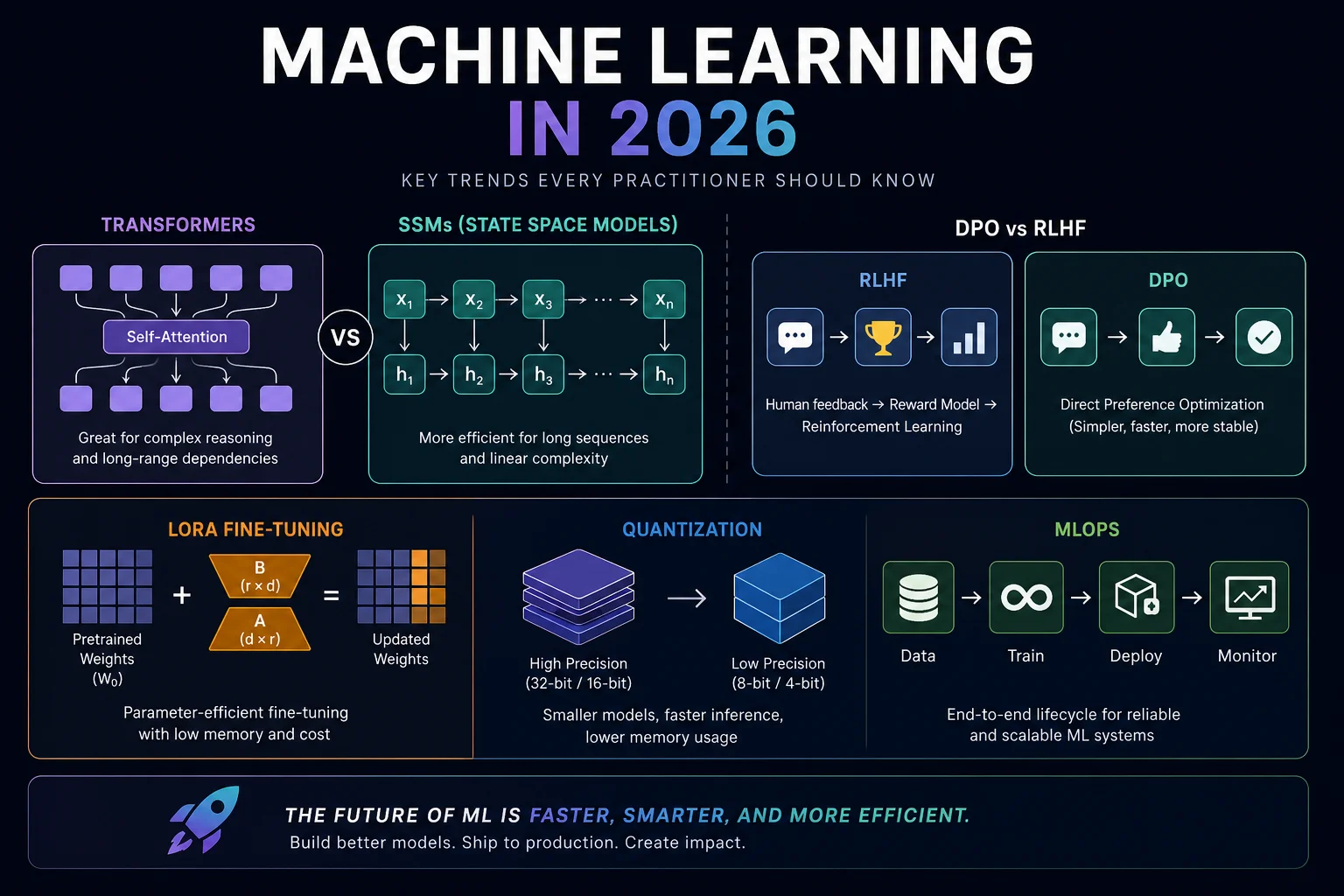
LoRA, introduced by researchers at Microsoft in a 2021 paper (LoRA: Low-Rank Adaptation of Large Language Models), is based on a critical insight: the weight updates made during fine-tuning have a low "intrinsic rank." In other words, the changes to the model's parameters can be represented by a much smaller set of numbers without significant loss of quality.
Instead of updating the full weight matrix \( W \in \mathbb{R}^{d \times k} \) for a given layer, LoRA freezes the original weights and injects two smaller matrices, \( A \in \mathbb{R}^{d \times r} \) and \( B \in \mathbb{R}^{r \times k} \), where \( r \) is a hyperparameter (typically 4, 8, or 16) much smaller than \( d \) and \( k \). The forward pass then becomes:
\[ h = W_0 x + BA x \]
This seemingly simple decomposition yields dramatic memory savings. For a layer with dimensions 4096×4096 (common in models like Llama 2 7B), full fine-tuning requires updating ~16.8 million parameters. With LoRA at rank \( r=8 \), only 65,536 parameters are trained—a reduction of over 99.6%. Practical implementations, such as the widely used Hugging Face PEFT (Parameter-Efficient Fine-Tuning) library, apply LoRA only to the attention projection matrices (Q, K, V, O) and sometimes to feed-forward layers, further optimizing the trade-off between efficiency and performance.
Key Benefits and Real-World Usage of LoRA
- Dramatic memory reduction: A 7B parameter model that requires ~56 GB for full fine-tuning can be adapted with LoRA using only 12–16 GB of GPU VRAM. This fits comfortably on a consumer-grade RTX 3090 or 4090.
- Fast training and low overhead: LoRA adapters train 2–4x faster than full fine-tuning because fewer gradients need to be computed. The adapters themselves are tiny—typically just 2–10 MB for a rank-8 configuration.
- Portable and versionable adapters: Since the base model remains unchanged, LoRA adapters can be stored, shared, and swapped like software plugins. Platforms like Hugging Face Hub host thousands of community-made LoRA adapters for tasks ranging from code generation to storytelling.
- No inference latency penalty: Once trained, the LoRA matrices can be merged into the original weights, resulting in zero additional inference cost. Alternatively, they can be kept separate for dynamic switching between tasks.
Tools like Axolotl, Unsloth, and the Hugging Face TRL library have made LoRA training accessible to anyone with a single GPU. For instance, Unsloth claims to reduce memory usage by 50% compared to standard LoRA implementations by optimizing the backward pass and using manual attention kernels.
QLoRA: Adding Quantization to the Equation
While LoRA dramatically reduces the number of trainable parameters, the base model still needs to be loaded into memory at full precision (16-bit or 32-bit floats). For a 70B model, this still requires 140 GB of VRAM in half-precision. QLoRA, introduced by Tim Dettmers and colleagues at the University of Washington in a 2023 paper (QLoRA: Efficient Finetuning of Quantized Language Models), solves this by quantizing the frozen base model to 4-bit precision before applying LoRA.
QLoRA introduces two key innovations:
- 4-bit NormalFloat (NF4) quantization: A new data type optimized for the normal distribution of neural network weights, achieving better accuracy than standard 4-bit integer quantization.
- Double quantization: The quantization constants themselves are quantized to 8-bit, saving an additional 0.5 bits per parameter without degrading quality.
- Paged optimizers: Using NVIDIA's unified memory to handle gradient checkpointing spikes, preventing out-of-memory errors during training.
The result is that a 65B parameter model (like the original Llama 65B) can be fine-tuned on a single 48 GB GPU (e.g., an A6000 or RTX 6000 Ada). For smaller models like Llama 3 8B, QLoRA training requires as little as 6 GB of VRAM, enabling fine-tuning on laptops and edge devices.
Performance Benchmarks: How Much Do You Lose?
The critical question for practitioners is: How much performance is sacrificed for this efficiency? Extensive benchmarks on tasks like MMLU (massive multitask language understanding), GSM8K (math reasoning), and HumanEval (code generation) show that LoRA typically recovers 90–95% of the performance of full fine-tuning. QLoRA adds a further 1–3% degradation due to quantization noise, but this gap narrows with careful hyperparameter tuning.
For example, a 2024 study comparing full fine-tuning, LoRA, and QLoRA on Llama 2 13B found:
- Full fine-tuning: MMLU score of 54.8%
- LoRA (rank 16): MMLU score of 54.1% (98.7% retention)
- QLoRA (4-bit, rank 16): MMLU score of 53.5% (97.6% retention)
For many practical applications—chatbots, document summarization, domain-specific Q&A—these small differences are imperceptible. The trade-off becomes even more favorable when considering that LoRA and QLoRA allow practitioners to iterate rapidly on multiple experiments in parallel.
Practical Implementation Guide for Developers
Getting started with LoRA or QLoRA is straightforward thanks to mature tooling. Here is a typical workflow using the Hugging Face ecosystem:
Step 1: Load a quantized base model
Use the bitsandbytes library to load a model in 4-bit or 8-bit precision. For example, loading Mistral 7B in 4-bit requires only ~4 GB of memory.
Step 2: Configure the LoRA adapter
Using PEFT, specify target modules (typically the query and value projection matrices), rank (often 8 or 16), and alpha scaling factor. A common starting point is r=8, lora_alpha=16, dropout=0.05.
Step 3: Prepare your dataset
Format your data as instruction-response pairs. Popular datasets for fine-tuning include OpenAssistant, ShareGPT, and domain-specific collections from Hugging Face Datasets.
Step 4: Train with TRL or Axolotl
The SFTTrainer class from TRL handles packing sequences and applying the LoRA adapter. Typical training takes 2–8 hours on a single GPU for a 7B model with 10,000 examples.
Step 5: Merge or deploy
Adapters can be merged into the base model using model.merge_and_unload(), or kept separate for dynamic loading via the PEFT library.
Current Landscape and Notable Models
The impact of LoRA and QLoRA is visible across the entire open-source LLM ecosystem. Many of the most popular fine-tuned models rely on these techniques:
- Mistral 7B Instruct and its fine-tuned variants (e.g., Zephyr, OpenHermes) were often adapted using LoRA, achieving top results on the Chatbot Arena leaderboard.
- Llama 3 (8B and 70B) has thousands of community LoRA adapters on Hugging Face, covering everything from medical coding to creative writing.
- StableLM 2 and Phi-3 both have official LoRA-optimized configurations, acknowledging that most users will fine-tune via PEFT rather than full retraining.
- Axolotl has become the de facto training framework for fine-tuning on consumer hardware, supporting QLoRA out of the box with a simple YAML configuration.
In production, companies like Replicate, Together AI, and Fireworks AI offer hosted fine-tuning APIs that use LoRA under the hood, charging per training hour rather than per GPU instance. This has made LLM customization accessible to solo developers and startups with limited budgets.
Limitations and When to Use Full Fine-Tuning
Despite their advantages, LoRA and QLoRA are not silver bullets. They have specific limitations:
- Rank saturation: For tasks that require learning entirely new capabilities (e.g., a new language or a drastically different domain), higher ranks (32–64) may be needed, reducing the memory advantage.
- Quantization overhead: QLoRA's 4-bit training introduces a slight slowdown (10–20%) compared to 16-bit LoRA due to dequantization operations during each forward pass.
- Multi-task degradation: When training for multiple diverse tasks simultaneously, full fine-tuning sometimes outperforms LoRA because it can update more parameters to accommodate conflicting objectives.
For most single-task fine-tuning scenarios—instruction following, style transfer, domain adaptation—LoRA and QLoRA deliver 95% of the benefit at 10% of the cost. The decision to use full fine-tuning should be reserved for cases where the model must learn fundamentally new knowledge or where the highest possible accuracy is non-negotiable and budget is not a constraint.
Conclusion
LoRA and QLoRA have fundamentally changed the economics of LLM customization. By exploiting the low-rank nature of weight updates and combining it with aggressive quantization, these techniques have lowered the barrier to entry from multi-GPU server clusters to a single consumer graphics card. For developers and tech professionals, the message is clear: there is no longer any reason to settle for a generic pre-trained model. With LoRA or QLoRA, anyone with a modest GPU can create a domain-specific, high-quality language model in hours rather than weeks. As the open-source ecosystem continues to produce better base models and more efficient training tools, low-rank adaptation will remain a cornerstone of practical AI deployment for years to come.